 ReelGenie
How to use Codex for social media posts
Codex can do much of the creative work if the right tools are available to you. A repeatable social workflow also needs a durable brand brief, a place to inspect the finished post, approval for the right account and evidence of delivery. That is the part ReelGenie handles.
Start free with ReelGenieReelGenie is separate from your Codex plan. You can judge the fit with one private Post before publishing.
What can Codex do, and where does ReelGenie help?
Codex can help research a topic, compare hooks, write a slide sequence and create original images when the necessary tools are available. It can also follow files and instructions you give it. Calling it incapable of remembering a brand would be wrong. The harder problem is making an agreed brief easy to retrieve across posts and people, then proving which version went to which account.
| Job | Codex contributes | ReelGenie contributes |
|---|---|---|
| Choose a useful post | Proposes angles, a hook, script and visual direction from your brief. | Stores the selected workspace's audience, goal, voice and boundaries for future posts. |
| Make the media | Creates and revises original images with the tools available to your plan. | Keeps the finished original files and copy; it does not fix weak generated art. |
| Send the post | Can prepare a private Post through the authorized ReelGenie connection. | Shows a preview, obtains approval, schedules or delivers through supported account paths, and records each result. |
The subscription you already pay for may cover part of the creative work, but it does not include a ReelGenie account or grant permission to a social network. OpenAI's current Codex plan guide explains that access and allowances vary; image-generation tools have their own availability and limits.
A one-post test that reveals whether the system helps
Start with a single post, not a content calendar. Pick one workspace and its audience. Tell Codex the post's one job—what should a viewer understand or do?—and ask it to propose two materially different angles. Choose the hook and cover concept before generating all the images.
For the [workspace] brand, read its saved ReelGenie content profile and list any missing audience, goal or desired-action fields. Propose two original carousel angles for [audience situation]. For each, give the exact cover hook, the first visual, the useful takeaway and how it serves the saved goal. Wait for my choice before making images.
Then inspect one cover and one interior slide at phone size. Check that the visuals deliver the same idea and that the wording is legible and accurate. Only then make the remaining slides and caption. If the creative fails here, fix it in Codex; adding ReelGenie will not rescue it.
Finally, hand the finished files to ReelGenie as a private review Post. Check the media order and complete copy in the console. A review link is a working result; it is not a published post. For the exact handoff and destination checks, use the last-mile guide.
Worked example: a finished post, a real approval, two outcomes
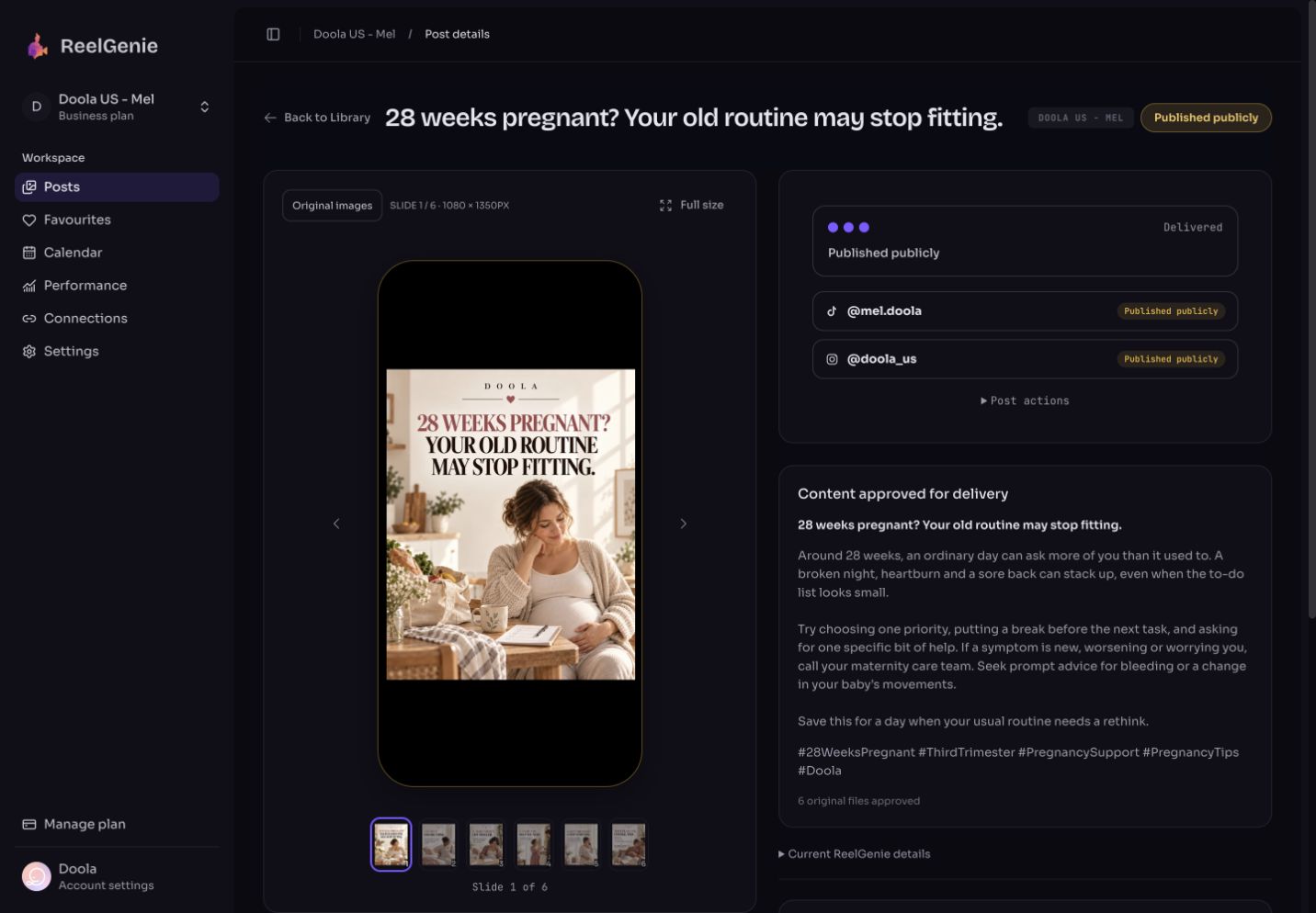
In the recorded Doola six-slide example, a saved cream-and-rose editorial reference informed the visual treatment. The new post chose its own topic: “28 weeks pregnant? Your old routine may stop fitting.” The cover and interior slide below show the chosen hook and a continued visual rhythm. The ReelGenie console shows the originals, approved caption and destination record together.


The creative decision: name the moment before introducing the product
The approved cover names a stage and a friction: “28 weeks pregnant?” and a routine that no longer fits. That is more specific than an illustrative alternative such as “5 reasons to download our pregnancy app.” The published caption follows with ordinary-day adjustments and a save prompt. Its immediate job is useful, saveable content; it is not a direct-response install ad. This is our reading of the finished work, not a transcript of the original creative discussion.
The handoff: approve the files and the destination together
The stored record contains six WebP originals at 1080 × 1350, the complete caption, and an approved version of both. On 27 September 2026, its history records explicit user confirmation in Codex for Instagram @doola_us and a TikTok @mel.doola inbox draft. Instagram then reported publication; TikTok recorded draft delivery. When rechecked on 29 September, both destination records reported public posts. The TikTok draft stage still required completion in TikTok.
Inspect the published Instagram carousel ↗ · Open the recorded TikTok post ↗
What to carry into the next post
Reuse the editorial spacing and the discipline of choosing a recognizable audience situation. Choose a new moment and a useful new takeaway. Keep a one-post “save this” objective separate from the brand’s longer-term acquisition goal. If the next post should drive app visits, its content needs a credible reason to visit the app; changing the final sentence alone may not be enough.
This is our own Doola operating example, not an independent customer testimonial. The files, approved copy and delivery history were checked against the live record on 29 September 2026. An earlier rejected draft and its corrections were not preserved in this record, so we cannot present a genuine before-and-after. No setup-time saving or incremental installs were measured.
When ReelGenie is—and is not—the right addition
Likely useful
You create posts repeatedly, manage more than one brand or account, need another person to review, or regularly lose time between final files and delivery. A shared brief, private preview and per-account result have clear value.
Probably unnecessary yet
You only brainstorm captions, make occasional images for manual posting, or have no connected destination to deliver to. Keep using Codex alone until the handoff becomes a real bottleneck.
ReelGenie also does not currently render video for you. It accepts finished video for supported delivery. The current public TikTok photo workflow delivers an inbox draft that you finish in TikTok; do not choose ReelGenie expecting universal unattended TikTok publication.
Measure the system, not a hopeful headline
The first practical measure is whether you can reliably move an approved original from a Codex conversation into a private Post and then to the correct destination. After delivery, compare the platform's actual result and the post's intended action. Views alone do not establish installs or purchases. Keep the next creative decision grounded in the audience response you can observe, not in a claim that AI made the account grow.
Use the guided Codex setup to connect one workspace. If your main challenge is keeping tones and goals separate, read the multi-brand workflow first.
Source and scope
Product roles, approval and delivery boundaries reflect the ReelGenie V4 publishing skill and the linked recorded Doola Post. Codex plan and tool availability are described by OpenAI. The decision guidance above is an inference from those capabilities, not measured buyer demand.